Showing posts with label Sir Alex. Show all posts

Sir Alex Unveils Road Sign: The Sir Alex Ferguson Way


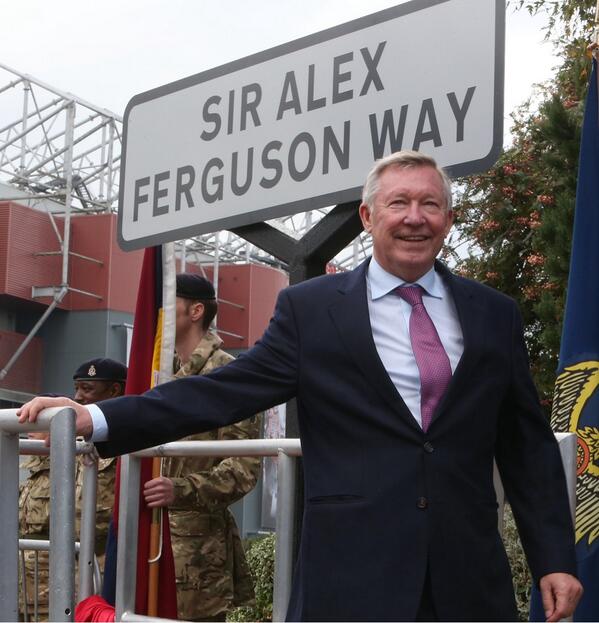
Former Manchester United manager Sir Alex Ferguson unveiled a road sign named in his honour on Monday afternoon.

 Embedded image permalink

The 71-year-old, who led United for 26 years before retiring in May, also received the Honourary Freedom of the Borough of Trafford at a formal ceremony at the council chambers. As part of the celebrations, Water’s Reach road was renamed Sir Alex Ferguson Way, and the manager unveiled the new sign in front of family, friends, fans and media on Monday afternoon.

Before doing the honours, Sir Alex addressed the gathered crowd: “It's a privilege and an honour to have a road named after me. You don't expect these things in life,” he said. “It encapsulates probably the last 26 years – coming to the great club, the history of it. It's been an incredible journey for me, ending today for me to unveil this road sign: Sir Alex Ferguson Way.

“I'm really proud of that and I'm proud of everyone who has been associated with the club. “I'd like to thank Manchester United for inviting me down here, 26 years ago. It was a fantastic elevation in my life and a challenge that I accepted. And we are where we are now. “It's a great, great football club. You, the supporters, have enjoyed it. And I still think that a lot of our young fans don't remember that there were bad days. Dealing with bad days is what we're good at. This club will always go on.

“We've got a fantastic set-up, great staff, wonderful people and there's only one way and that's up for Manchester United. “I thank everybody for being here – all my friends, all my family and my wife, the boss! She picked all the winning teams, by the way. “Thanks for coming here, Thanks for the Mayor and Trafford Borough for this fantastic honour and the day we've had today at the Town Hall. It's been absolutely brilliant. “I'm going to unveil this, so thanks once again for the honour of doing this.”
Read more »

Sir Alex Ferguson Honoured Today


Former Manchester United manager Sir Alex Ferguson will receive Honourary Freedom of the Borough of Trafford today, Monday 14 October, at a formal ceremony.


Held at the Trafford Town Hall, the ceremony will honour Sir Alex for his many achievements as manager of Manchester United between 1986 and 2013.

The 71-year-old will not only receive Honourary Freedom of the Borough of Trafford but a street running adjacent to Manchester United’s Old Trafford stadium, Water’s Reach, will be renamed Sir Alex Ferguson Way. The street will become one of three in the area named after sporting icons: the others are Sir Matt Busby Way and Brian Statham Way.

When the plans to honour Sir Alex were announced in September he said: "I am delighted to accept this from Trafford Council. When I arrived at Old Trafford in 1986 I had little idea of the journey that awaited me. 

"Over quarter of a century later, to receive the Freedom of the Borough of Trafford, and to have a part of Trafford carrying my name, is truly humbling."
Read more »

Sir Alex Ferguson Reveals Secret Of His Success With Manchester United


Former Manchester United manager Sir Alex Ferguson has said that from the moment he came to the club, he only thought of building a football side right from the bottom, and that it was very difficult to survive as a manager in the current era.

 'Winner' Fergie reveals secret to success at Man Utd

According to The Guardian, Ferguson expressed that he set high standards for United and had to lift player expectations, along with never giving in.

The former manager said that superstars with egos was not that big a problem as people thought because winning always massaged their egos as was the case with Ronaldo, Beckham, Giggs and Scholes.

The legend said that winning was his nature and there was no other option for him, adding that even if the team won 3-2, it was a fantastic feeling for him. Ferguson said that he had to adapt to new changes in the game as there were no agents during his time and the media did not elevate players to the level of film stars.
Read more »

Road Named After Sir Alex Ferguson


Sir Alex Ferguson has spoken of his pride at being honoured by Trafford Council.


The former Manchester United boss has been given the freedom of the Borough and Water's Reach, situated close to Old Trafford, will be renamed 'Sir Alex Ferguson Way'.

The road is opposite Sir Matt Busby Way towards Salford Quays with the formalities taking place during a meeting of councillors on 14 October.

"I am delighted to accept this honour from Trafford Council," stated Sir Alex. "When I arrived at Old Trafford in 1986, I had little idea of the journey that awaited me. "Over quarter of a century later, to receive the Freedom of the Borough of Trafford and to have a part of Trafford carrying my name is truly humbling."
Read more »

Manchester United Greatest Manager Greatest Quotes


Sir Alex Ferguson's trophy-laden reign at Manchester United has been illuminated by his often fiery rhetoric. From withering put-downs to sparkling praise, the Scot has eye for an apposite phrase and has created a few catalogue of memorable quotes. 


Alex Ferguson retires: Manchester United manager's greatest quotes
Sir Alex Ferguson is the king of the one-liners
On his mission after being appointed to the post:
"My greatest challenge is not what's happening at the moment, my greatest challenge was knocking Liverpool right off their f***ing perch. And you can print that."

On whether Liverpool would win the title in 2007:
"You must be joking. Do I look as if I'm a masochist ready to cut myself? How does relegation sound instead?"

On Manchester City's emergence as a Premier League force:
"There has been a lot of expectation on Manchester City and with the spending they have done, they have to win something. Sometimes you have a noisy neighbour and have to live with it. You can't do anything about them."
On Manchester City's Carlos Tévez poster:
"It's City, isn't it? They are a small club, with a small mentality. All they can talk about is Manchester United, that's all they've done and they can't get away from it."

On Jose Mourinho:
"He was certainly full of it, calling me 'Boss' and 'Big Man' when we had our post-match drink after the first leg. But it would help if his greetings were accompanied by a decent glass of wine. What he gave me was paint-stripper."

On Arsene Wenger:
"They say he's an intelligent man, right? Speaks five languages. I've got a 15-year-old boy from the Ivory Coast who speaks five languages!"

On Rafael Benitez:
"I think he is very concerned about his CV, he refers to it quite a lot."

On his bust-up with Newcastle boss Alan Pardew:
"The press have had a field day. The only person they have not spoken to is Barack Obama because he is busy."

On the infamous incident during which former midfielder David Beckham was struck on the head by a flying boot:
"It was a freakish incident. If I tried it 100 or a million times it couldn't happen again. If I could I would have carried on playing!"

On the mind games employed by Italian teams:
"When an Italian tells me it's pasta on the plate, I check under the sauce to make sure. They are the inventors of the smokescreen."

On seeing Ryan Giggs as a schoolboy:
"I remember the first time I saw him. He was 13 and just floated over the ground like a cocker spaniel chasing a piece of silver paper in the wind."

On the 2003 title race:
"It's getting tickly now - squeaky-bum time, I call it."

On Gary Neville:
"If he was an inch taller he'd be the best centre-half in Britain. His father is 6ft 2in - I'd check the milkman." 

Manchester United after winning the dramatic final of the UEFA Champions League 1998-99
On United's dramatic Champions League final victory over Bayern Munich in 1999:
"I can't believe it. I can't believe it. Football. Bloody hell."

On media criticism of Juan Sebastián Verón:
"On you go. I'm no f****** talking to you. He's a f****** great player. Yous are f****** idiots."

On referee Alan Wiley:
"The pace of the game demanded a referee who was fit. It is an indictment of our game. You see referees abroad who are as fit as butcher's dogs. We have some who are fit. He wasn't fit. He was taking 30 seconds to book a player. He was needing a rest. It was ridiculous."
 
On Wayne Rooney's decision to sign a new contract:
"Sometimes you look in a field and you see a cow and you think it's a better cow than the one you've got in the field."

On Real Madrid's hopes of signing Cristiano Ronaldo:
"Do you think I would get into a contract with that mob? Jesus Christ, no chance. I wouldn't sell them a virus."

On Filippo Inzaghi:
"That lad must have been born offside."

On retirement:
"The decision to retire is one that I have thought a great deal about and one that I have not taken lightly. It is the right time." 

RELATED ARTICLES 


Read more »

Why History Will Remember Sir Alex Ferguson As The Greatest Football Manager Ever


Alex Ferguson retires: Manchester United manager can claim to be the best - thanks to Aberdeen achievements
Champions: Sir Alex Ferguson's achievements, when totted up, make him the best-ever manager to have graced football
There was once a debate over whether Sir Alex Ferguson merited a place alongside Bill Shankly, Sir Matt Busby, Jock Stein, Brian Clough, Sir Alf Ramsey and Bob Paisley in the pantheon of great British football managers. That debate was emphatically ended by about the mid-1990s. 

The next debate was whether Ferguson could be regarded as the finest of those illustrious British managers. Again, that particular debate was surely settled some years ago. Arguably that was the case when Manchester United won the treble in 1999 but most definitely once he lifted a second European Cup in 2008.

With Ferguson taking the momentous decision to retire, the more interesting question now is just where he rates alongside the best managers in the history of world football. From Rinus Michels to Jose Mourinho and Ernst Happel to Miguel Munoz, this brings an entirely different list of candidates and achievements. Yet, once again, the evidence for Ferguson is favourable.

Broadly speaking, there have been three types of great managerial achievers. Firstly, there are those who have worked under big pressure at big clubs with big players and still consistently delivered trophy after trophy. The second group of managerial greats are those who have achieved their success against the odds in unfavourable conditions or at unfashionable clubs.

Finally, there are the managers who have particularly distinguished themselves by implementing a certain style for their teams that has altered the way the rest of the world thinks about football.
Ferguson is unique in that he has ticked each of those boxes at different stages of a truly extraordinary 39-year career. 

As well as Paisley, there are those who have a superior trophy-winning strike-rate. Fabio Capello, for example, won nine Italian or Spanish league titles at four different clubs over a period of just 15 years. Similarly, Mourinho won seven league titles, as well as two European Cups, in nine completed seasons at Porto, Chelsea, Inter Milan and Real Madrid. 

Then there is Munoz, the Real Madrid manager during much of the 1960s, who won nine La Liga titles in 12 years, as well as two European Cups. Others who have created great dynasties of success include Jock Stein at Celtic and Giovanni Trapattoni at Juventus. Yet no manager in the major leagues can equal Ferguson's domestic haul of 13 titles. 

Of the great managers who have achieved success against the odds, Happel arguably trumps even Clough for winning the European Cup with two unfashionable teams in Feyenoord and Hamburg.
The achievements of Guus Hiddink at so many different levels, but particularly South Korea in the World Cup and PSV Eindhoven in Europe, also stand out. 

We then come to the final group of managerial greats; those coaches who have helped change the way their contemporaries think about football. Arrigo Sacchi built a dynasty at AC Milan that owed much to wonderful defending, while Arsène Wenger has delivered more than just silverware with the style of successive Arsenal teams. The greatest influencer of other teams, however, has surely been Michels. 

He is credited with originating Total Football in the late 1960s and was also a winner of trophies, including the European Cup with Ajax, the Spanish League with Barcelona and the European Championships of 1988 with Holland. What's more, Michel's Dutch team of 1974 also remains widely regarded as the best not to win the World Cup. It is some CV and provides perhaps the best theoretical challenge to Ferguson's status as the greatest of all-time. 

Yet as well as winning so regularly, Ferguson can also claim to have stamped a certain style on his club. In 27 years at Manchester United, his teams have been consistently thrilling to watch, while the tactical changes he has made since 2000 have produced a particularly fluid and adaptable approach. His most recent teams, which have won five Premier League titles in seven years and reached three Champions League finals in five seasons, have developed a devastating counter-attacking style that has influenced others across the world. 

Ferguson will, of course, be primarily assessed according to his remarkable feats with Manchester United yet add on his achievements at Aberdeen and the debate is surely ended in his favour. To consistently break the Old Firm dominance of Celtic and Rangers was one thing but to guide them to victory in a major European final against Real Madrid represented an individual achievement comparable to Clough's two European Cups at Nottingham Forest. 

Quite simply, Ferguson has proved that he can thrive in any environment. He has been the supreme man-manager, whether dealing with millionaire celebrities at United or players at smaller Scottish clubs who might simply have been happy to afford the rent at the end of the week. Having consistently won trophies across five decades since the 1970s, his longevity also sets him apart. So does the ability to constantly evolve and reinvent his teams. 

I remember once interviewing Gordon Strachan, who spent 10 years of his life at Aberdeen and Manchester United being managed by Ferguson. The pair had some famous fallings out but he is in no doubt that Ferguson is the best manager of all-time. “When he was at St Mirren, they say it was the best team they ever had,” said Strachan. “Then he did the same at Aberdeen and then again at Manchester United. It’s no coincidence.” 

Strachan then singled out two key attributes. “You can have all the sports psychologists you like but, in terms of motivating people, he is the best,” he said. Strachan then explained how Ferguson has almost a sixth-sense when it comes to watching players train and knowing when they are in peak form and fitness. “It’s like a trainer watching his horses on the gallops”, he said. There are qualities which have endured and allowed him to conquer an extraordinary series of challenges. No one could have imagined that he would win nine major trophies with Aberdeen or so emphatically end Liverpool's dominance of English football. 

There were also times when he looked likely to be submerged by the brilliant teams of Wenger at Arsenal, Mourinho at Chelsea and, most recently, the emergence of those "noisy neighbours" at Manchester City. He always found the right answer and, even without a third European Cup, Ferguson’s legacy is already secure. History should remember him not just as Britain's finest football manager but the best that the world has ever seen.

RELATED STORIES

The Complete 2013-14 Barclays Premier League Fixtures

Manchester United 2013-14 Barclays Premier League Fixtures 


Read more »

Thank You Sir Alex Ferguson


History Of The World's Greatest Football Manager ! 


Sir Alex Ferguson

Premier League1993, 1994, 1996, 1997, 1999, 2000, 2001, 2003, 2007, 2008, 2009, 2011, 2013
FA Cup1990, 1994, 1996, 1999, 2004
League Cup1992, 2006, 2009, 2010
UEFA Champions League1999, 2008
FIFA Club World Cup2008
UEFA Super Cup1992
UEFA Cup Winners Cup1991
Inter-Continental Cup1999
FA Charity / Community Shield1990 (shared), 1993, 1994, 1996, 1997, 2003, 2007, 2008, 2010, 2011


Sir Alex Ferguson is the most successful manager in British football history, winning almost 40 trophies – including 13 Premier League titles – during his time in charge of Manchester United.

He arrived at Old Trafford on 6 November 1986 and retired at the end of the 2012/13 season. Ferguson enjoyed a playing career in Scotland that saw him take in spells with Queen's Park, St Johnstone, Dunfermline, Glasgow Rangers, Falkirk and Ayr United. But it is not for his playing of the game that Sir Alex was to become a success.

Following a spell out of the game he moved into coaching, taking up the role of manager of East Stirlingshire, St Mirren then Aberdeen. It was his time at Pittodrie where he earned his reputation as a top coach. He broke the Glasgow dominance of Scottish football to lead Aberdeen to three Scottish titles, four Scottish cups, one League Cup and one European Cup Winners’ Cup.

Following the sacking of Ron Atkinson as manager of Manchester United in 1986, the Old Trafford hierarchy moved quickly for his services. Ferguson inherited a dispirited team of underachievers who had consistently, to their supporters’ discontent, failed to break Liverpool’s domination. Stuck in the bottom four of the Division One table, Ferguson immediately set about attempting to stave off the very real threat of relegation. Without resorting to the transfer market, he guided United up the table to an 11th place finish.

By now it was clear to Ferguson that he faced a major job in turning the club around. United were an entertaining side but one that seemed unable to cope with the more physical aspects of League football. In his second season the Reds fared better finishing second behind Liverpool, but the position painted a false picture. The turning point came in the 1989/90 season.

Following a run of games in which the Reds were drawn away in every round, United picked up their first silverware of the Ferguson era. Lee Martin scoring the only goal in a final replay against Crystal Palace to win the FA Cup.

This first trophy opened the floodgates. The European Cup Winners’ Cup was won the following season in Rotterdam, Barcelona defeated 2-1 thanks to a brace from Mark Hughes. Then, in 1991/92, the League Cup was added to United’s list of honours. Sadly the title remained elusive. It was the Holy Grail to United fans, the 26 championships-free years being exacerbated by Liverpool’s dominance of the domestic and European game.

In 1992/93 the long wait for the League championship came to an end with the Reds, inspired by £1m signing Eric Cantona, pipping Aston Villa in the final weeks of the season. The shackles were broken: the Double followed in 1993/94, the double-Double (with ‘kids’) in 1995/96, and another title in 1997. Finally United were matching off-field might with on-field success. Liverpool’s dominance was well and truly over.

Sir Alex’s greatest achievement came in 1998/99. No side before or since has achieved a Treble haul of Premiership title, FA Cup and European Cup. On an unforgettable night in Barcelona his decision to throw on substitutes Teddy Sheringham and Ole Gunnar Solskjaer assured history was made. The pair scored injury-time goals to win the Champions League and complete the Treble.

Ferguson was knighted following that success and some suggested he should retire, believing his desire would wane following the realisation of a dream. Not a bit of it. Another title followed in 1999/2000 and he made it three-in-row in 2000/01. His eighth Premiership duly arrived in 2002/03; his fifth FA Cup came a year later, against Millwall in Cardiff.

The Reds had by now entered a period of rebuilding. The side of homegrown players he’d first put together in 1995/96 was now breaking up and he’d recruited new stars like Wayne Rooney and Cristiano Ronaldo to spark a new era of success.

The rebuilding paid off with victory in the Carling Cup in 2005/06 and a ninth Premier League trophy in 2006/07. In May 2007, Sir Alex swooped for three players - Anderson, Nani and Owen Hargreaves - to bolster an already strong squad. This evolving team claimed more glory in 2007/08, defending the Premier League title and securing Sir Alex's second Champions League triumph with all three of those signings scoring in the penalty shoot-out against Chelsea.

United followed European success by winning the FIFA Club World Cup in Japan in December 2008. The Reds then claimed the Carling Cup in March 2009 by beating Tottenham on penalties in the final.

On 16 May 2009, United achieved what had seemed an impossible mission when Sir Alex arrived in 1986, equalling Liverpool's long-standing record of 18 league championships. Beating Liverpool to the 2008/09 crown – Sir Alex's 11th title in 17 seasons – made the feat even sweeter.

Even better was to follow two years later. After being pipped to the championship by a point by Double winners Chelsea, United had to settle for the Carling Cup as the only trophy of 2010. But the Reds wrestled the Premier League title back with typical determination as Wayne Rooney's penalty at Blackburn ensured United surpassed Liverpool as the most successful club in the domestic game.

There was final-day heartbreak in 2011/12 as Manchester City pipped the Reds to the league title with just seconds of the season remaining. That disappointment made the manager doubly determined to reclaim the trophy in 2012/13 – his final season in charge – and his side delivered a fitting send-off to by clinching the club's 20th league title with four games to spare.

Sir Alex will continue to be involved at United following his retirement, taking up a position on the club's board and acting as an ambassador.

RELATED STORIES


Why History Will Remember Sir Alex Ferguson As The Greatest Football Manager Ever
Read more »